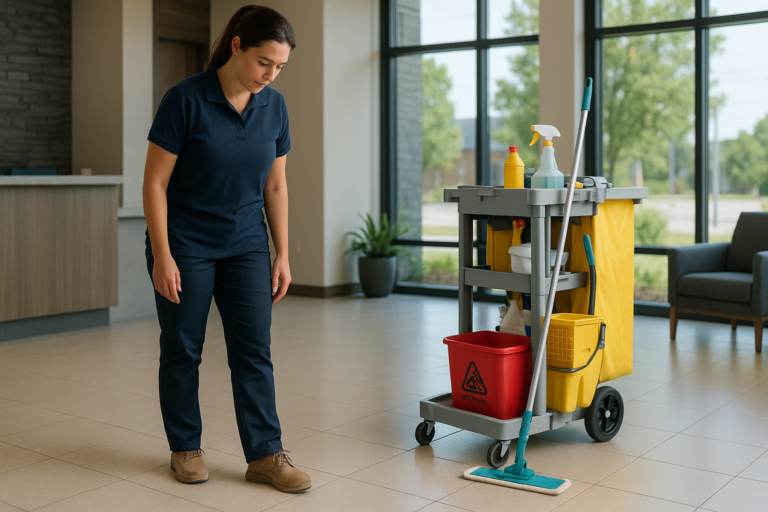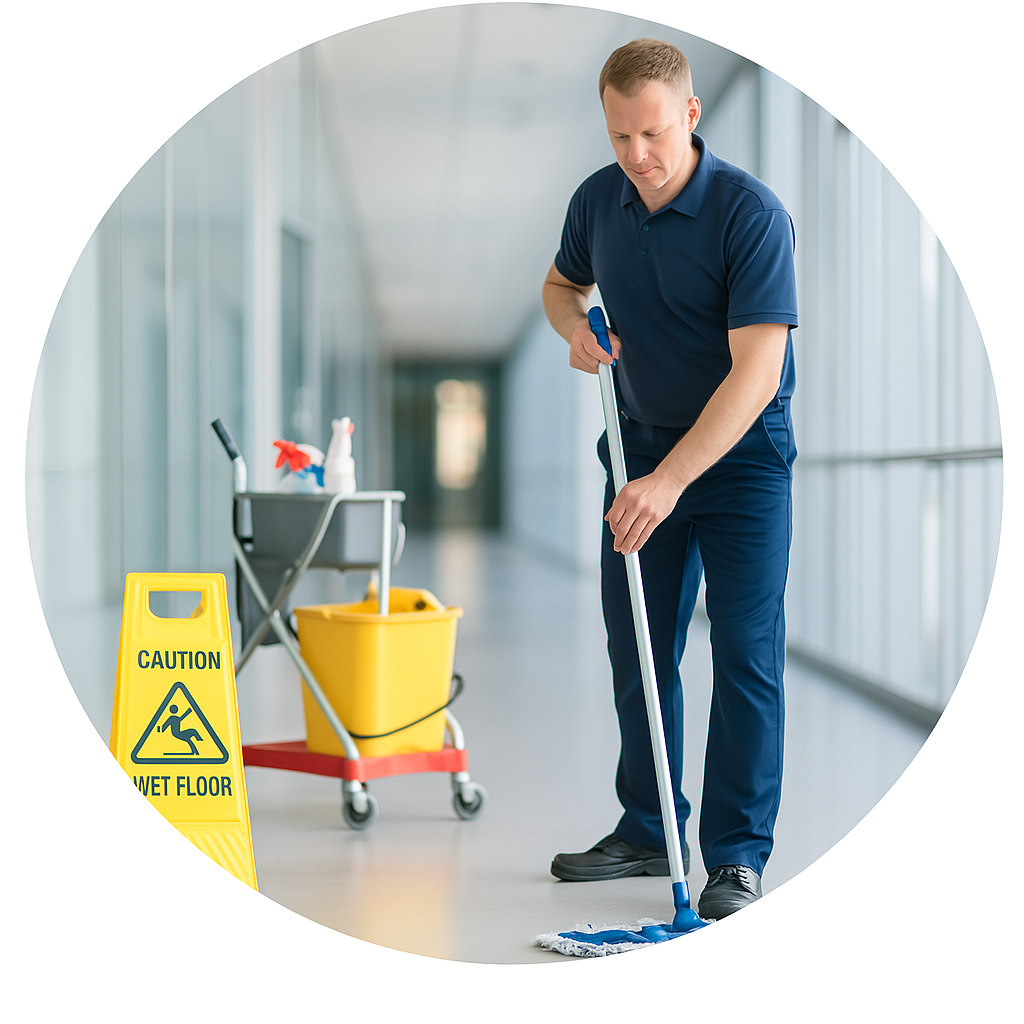
When you hire a commercial cleaning company, you’re trusting them with more than your floors and countertops — you’re trusting them with your employees’ health, your clients’ first impression, and your facility’s long-term condition. At Clean Scene, the commercial cleaning products we use in Maine businesses aren’t chosen by accident. Every bottle, cloth, and piece of equipment in our kits has earned its place.
Here’s a transparent look at what we use, why we use it, and what we deliberately avoid.
Why We’re Selective About What Goes in Our Kits
Not all cleaning products are created equal. Walk down any grocery store aisle and you’ll find dozens of options — but consumer-grade products aren’t designed for the demands of a commercial environment. An office that sees 30 people daily, a medical waiting room with high touchpoint traffic, or a restaurant kitchen require a different class of product entirely.
We evaluate every product we carry on three criteria:
- Effectiveness — Does it actually eliminate pathogens, cut grease, or remove buildup at the concentrations we use it?
- Safety — Is it safe for the people in the building, our crew, and the surfaces we’re cleaning?
- Compatibility — Does it work with the surfaces common in Maine commercial properties, including hardwood, LVT, tile, and finished concrete?
If a product doesn’t pass all three, it doesn’t make the cut.
The 5 Commercial Cleaning Products We Trust
1. EPA-Registered Hospital-Grade Disinfectants
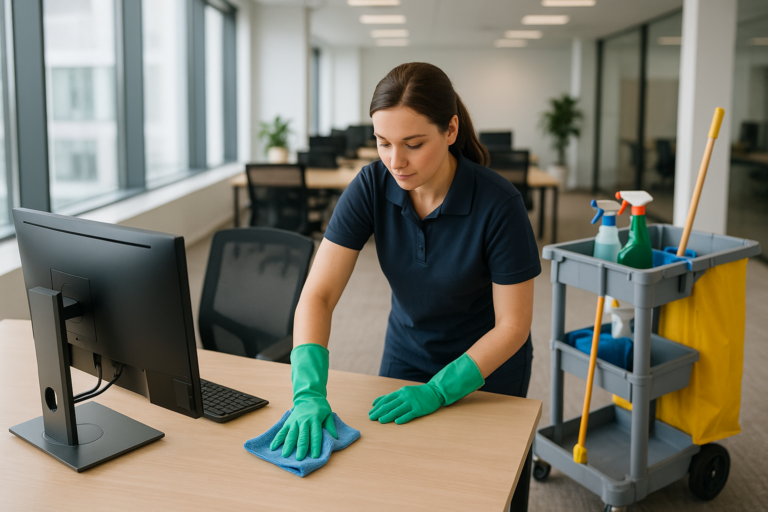
For high-touch surfaces — door handles, light switches, elevator buttons, breakroom counters — we use EPA List N disinfectants that are registered and tested against viruses, bacteria, and fungi. These aren’t all-purpose sprays you’d find under a sink at home. They’re the same class of product used in medical facilities and schools.
Why it matters: Maine’s cold and flu season runs from October through April. A disinfectant that only reduces surface bacteria by 50% isn’t protecting your team — it’s theater. We use products with kill claims verified by independent lab testing.
We reference the EPA’s registered disinfectant database when selecting and updating our product lineup.
2. Commercial-Grade Microfiber Cloths and Mop Heads
Microfiber isn’t just a buzzword. Commercial microfiber cloths have a fiber density and electrostatic charge that regular cotton cloths can’t match — they lift and trap particles at the micron level rather than just pushing them around. Research from infection control experts has shown microfiber reduces microbial contamination on surfaces significantly versus traditional cleaning cloths.
We launder our microfiber between every job and retire cloths on a set replacement schedule. A worn-out microfiber is just a rag.
3. Color-Coded Supply Systems
This one surprises people. The color of a cloth or bucket might seem like a minor detail — it’s one of the most important contamination controls we run.
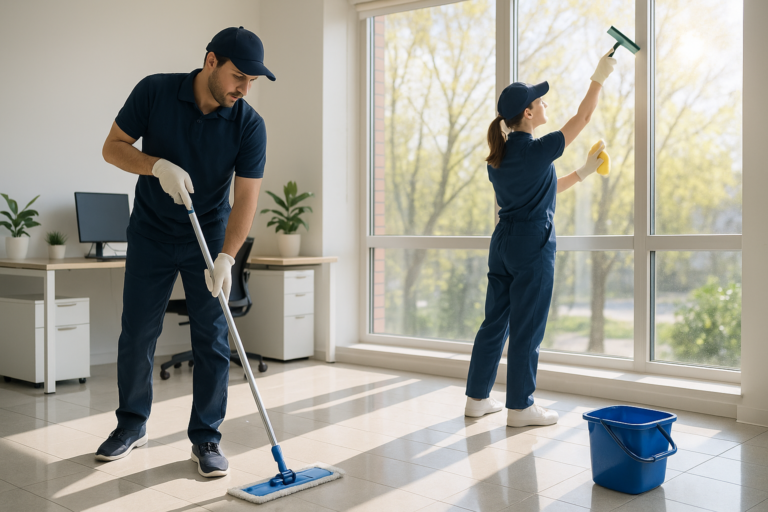
Our color-coding system: Red for restrooms and high-risk areas. Blue for general office surfaces. Green for kitchens and breakrooms. Yellow for glass and windows. No cloth from a restroom ever touches a breakroom counter. No exceptions, ever.
Cross-contamination is one of the most common and least visible failures in commercial cleaning. Color-coding makes the right process automatic, even across a crew of multiple cleaners.
4. Low-VOC Neutral Floor Cleaners
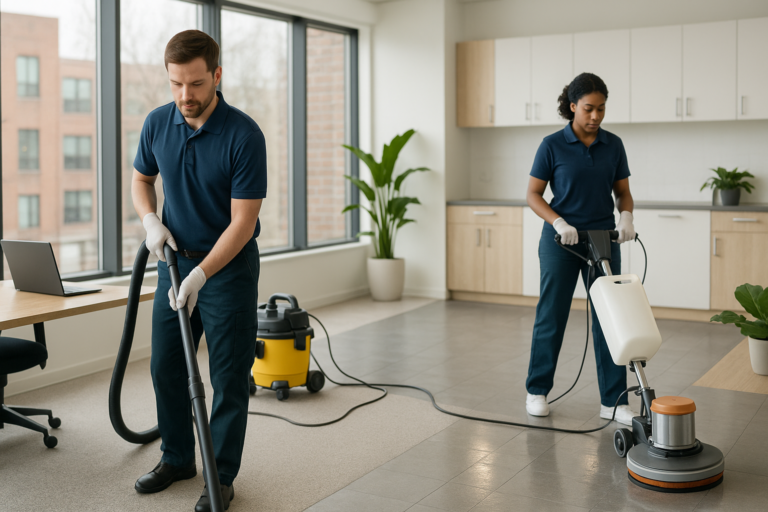
Harsh floor cleaners with high VOC (volatile organic compound) content can leave residue that attracts dirt faster, dulls floor finishes over time, and creates indoor air quality problems — especially in tightly-sealed Maine buildings during winter months. We use pH-neutral, low-VOC floor solutions compatible with the LVT, hardwood, and polished concrete common in Bangor-area commercial buildings.
The result: floors that stay cleaner longer between services, and a building that doesn’t smell like a swimming pool after we leave.
5. HEPA-Filter Backpack Vacuums
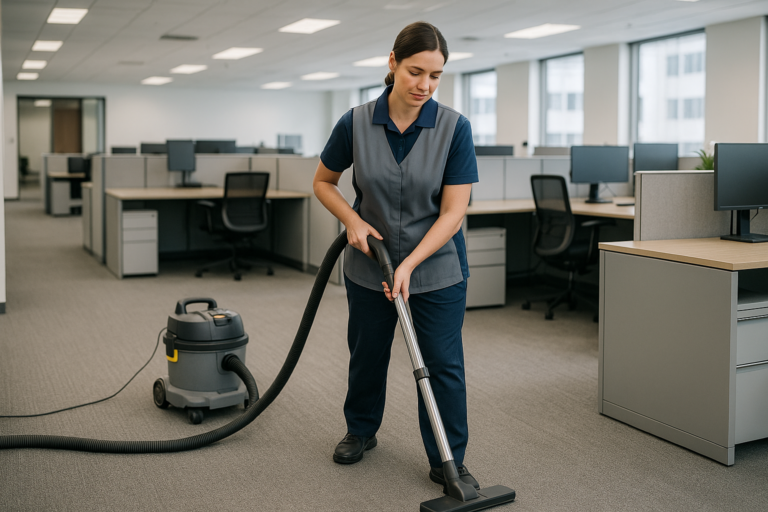
Our vacuums aren’t warehouse specials. We use commercial backpack vacuums with genuine HEPA filtration — capturing 99.97% of particles 0.3 microns or larger. That includes dust mite debris, mold spores, and fine particulate that standard vacuums just recirculate into the air.
In an office environment, air quality directly affects employee productivity and sick days. HEPA filtration is one of the easiest ways a cleaning company can contribute to healthier indoor air — and one of the most commonly cut corners.
What We Don’t Use
Being selective means saying no. We don’t use:
- Bleach on stone or grout — it degrades surfaces and the “clean” smell doesn’t mean it worked better
- Ammonia-based products near electronics — corrodes contacts and coatings
- Aerosol sprays in occupied spaces — unnecessary chemical exposure for building occupants
- Mystery “multi-surface” concentrates of unknown origin — if it’s not EPA-registered or third-party tested, it doesn’t go in our kits
The Maine Factor
Commercial cleaning in Maine has specific demands that national chains trained elsewhere sometimes miss. We deal with:
- Salt and sand tracking from November through April — our entrance mat protocols and floor care products are built around this
- High humidity in summer creating mold risk in certain building types — we use mold-inhibiting products in vulnerable areas
- Heating season dust from forced-air systems running hard — we adjust our dusting and air filtration approach seasonally
Six years of cleaning Maine businesses has given us a product toolkit tuned to local conditions, not just whatever works in Florida or Phoenix.
What This Means for Your Business
The cleaning products inside your facility matter. They affect how long your floors last, how healthy your air is, and whether pathogens are actually being eliminated or just relocated. At Clean Scene, we take that seriously enough to invest in the right products — and to train our team on using them correctly.
If you want to see our process in person, reach out for a free walkthrough and quote. We’ll show you exactly what we’d use in your building and why. Or explore our commercial cleaning services to learn more about what we offer Bangor-area businesses.